I want to archive and then delete completed process instances data from Elasticsearch (used by Camunda Operate).
Based on my analysis, I planned to use an Elasticsearch ILM policy named operate_delete_archived_indices and then apply it to indices like:
operate-list-view-8.3.0_2026-02-19
However, after a fresh Camunda installation via Helm, the expected ILM policy does not seem to be created automatically.
a { text-decoration: none; color: #464feb; } tr th, tr td { border: 1px solid #e6e6e6; } tr th { background-color: #f5f5f5; }
What I expected
- The Helm deployment to create (or wire) an ILM policy for Operate indices, or at least make it clear how to attach a custom ILM policy to indices like
operate-list-view-*. - Ability to archive (e.g., snapshot/export) completed data and then delete indices containing completed instances after a retention period.
a { text-decoration: none; color: #464feb; } tr th, tr td { border: 1px solid #e6e6e6; } tr th { background-color: #f5f5f5; }
What actually happened
- No ILM policy is present after the fresh install (I was expecting something like
operate_delete_archived_indices). - I therefore attempted to create and attach the ILM policy via the Elasticsearch APIs.
a { text-decoration: none; color: #464feb; } tr th, tr td { border: 1px solid #e6e6e6; } tr th { background-color: #f5f5f5; }
What I tried
1) Create ILM policy
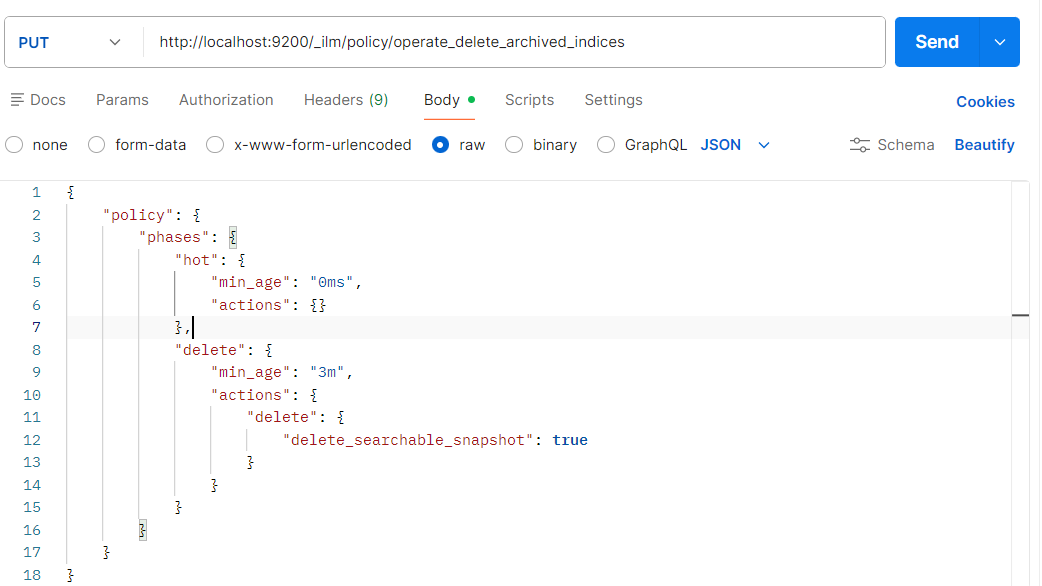
a { text-decoration: none; color: #464feb; } tr th, tr td { border: 1px solid #e6e6e6; } tr th { background-color: #f5f5f5; }
2) Attach ILM policy to the index
Endpoint
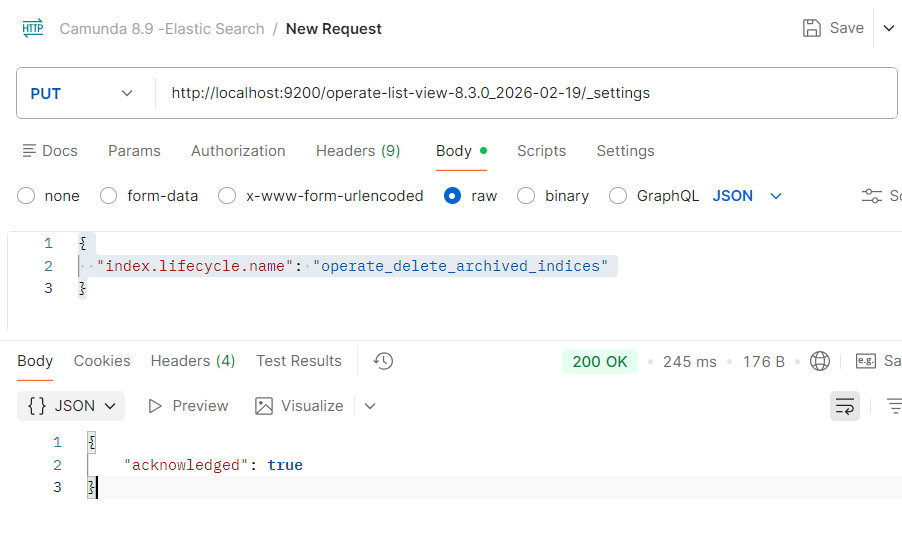
camunda-values.yaml :
global:
  elasticsearch:
    enabled: true
  secrets:
    autoGenerated: true
    name: "camunda-credentials"
  identity:
    auth:
      enabled: true
      publicIssuerUrl: "http://localhost:18080/auth/realms/camunda-platform"
      webModeler:
        redirectUrl: "http://localhost:8070"
      console:
        redirectUrl: "http://localhost:8087"
      optimize:
        redirectUrl: "http://localhost:8083"
        secret:
          existingSecret: "camunda-credentials"
          existingSecretKey: "identity-optimize-client-token"
      orchestration:
        redirectUrl: "http://localhost:8080"
        secret:
          existingSecret: "camunda-credentials"
          existingSecretKey: "identity-orchestration-client-token"
      connectors:
        secret:
          existingSecret: "camunda-credentials"
          existingSecretKey: "identity-connectors-client-token"
  security:
    authentication:
      method: oidc

identity:
  enabled: true
  firstUser:
    secret:
      existingSecret: "camunda-credentials"
      existingSecretKey: "identity-firstuser-password"

identityKeycloak:
  enabled: true
  postgresql:
    auth:
      existingSecret: "camunda-credentials"

connectors:
  enabled: true
  security:
    authentication:
      method: oidc
      oidc:
        secret:
          existingSecret: "camunda-credentials"
          existingSecretKey: "identity-connectors-client-token"

webModeler:
  enabled: true
  restapi:
    mail:
      fromAddress: noreply@example.com

webModelerPostgresql:
  resources:
    requests:
      cpu: "50m"
      memory: "128Mi"
    limits:
      cpu: "150m"
      memory: "256Mi"
  enabled: true
  auth:
    existingSecret: "camunda-credentials"
    secretKeys:
      adminPasswordKey: "webmodeler-postgresql-admin-password"
      userPasswordKey: "webmodeler-postgresql-user-password"

orchestration:
  image:
    repository: zeebe-mongodb-exporter
    tag: 8.8.11-mongodb-v2
    pullPolicy: Never
  resources:
    requests:
      cpu: "500m"
      memory: "256Mi"
    limits:
      cpu: "1"
      memory: "1Gi"
  enabled: true
  clusterSize: "1"
  partitionCount: "1"
  replicationFactor: "1"

  exporters:
    mongodb:
      className: io.github.camunda8.mongodb.exporter.MongoDBExporter
      jarPath: /usr/local/zeebe/exporters/camunda8-mongodb-exporter-1.0-SNAPSHOT.jar
      args:
        # ⛔ REDACTED: Do not post real credentials/hosts/params
        connectionUri: "mongodb+srv://<USERNAME>:<PASSWORD>@<CLUSTER_HOST>/<PARAMS>"
        database: "<DB_NAME>"
        collection: "<COLLECTION_NAME>"
        batchSize: 100
        flushInterval: 1000

  env:
    - name: LOGGING_LEVEL_IO_GITHUB_CAMUNDA8
      value: "DEBUG"

    # MongoDB Exporter configuration (REDACTED)
    - name: ZEEBE_BROKER_EXPORTERS_MONGODB_CLASSNAME
      value: io.github.camunda8.mongodb.exporter.MongoDBExporter
    - name: ZEEBE_BROKER_EXPORTERS_MONGODB_JARPATH
      value: /usr/local/zeebe/exporters/camunda8-mongodb-exporter-1.0-SNAPSHOT.jar
    - name: ZEEBE_BROKER_EXPORTERS_MONGODB_ARGS_CONNECTIONURI
      value: "mongodb+srv://<USERNAME>:<PASSWORD>@<CLUSTER_HOST>/<PARAMS>"
    - name: ZEEBE_BROKER_EXPORTERS_MONGODB_ARGS_DATABASE
      value: "<DB_NAME>"
    - name: ZEEBE_BROKER_EXPORTERS_MONGODB_ARGS_COLLECTION
      value: "<COLLECTION_NAME>"
    - name: ZEEBE_BROKER_EXPORTERS_MONGODB_ARGS_BATCHSIZE
      value: "100"
    - name: ZEEBE_BROKER_EXPORTERS_MONGODB_ARGS_FLUSHINTERVAL
      value: "1000"

    # CamundaExporter (Elasticsearch) - Archiving Configuration (LOCAL TESTING)
    - name: ZEEBE_BROKER_EXPORTERS_CAMUNDAEXPORTER_ARGS_HISTORY_WAITPERIODBEFOREARCHIVING
      value: "1m"
    - name: ZEEBE_BROKER_EXPORTERS_CAMUNDAEXPORTER_ARGS_HISTORY_ROLLOVERINTERVAL
      value: "1h"
    - name: ZEEBE_BROKER_EXPORTERS_CAMUNDAEXPORTER_ARGS_HISTORY_ROLLOVERBATCHSIZE
      value: "3"
    # Retention (LOCAL TESTING - 3 min)
    - name: ZEEBE_BROKER_EXPORTERS_CAMUNDAEXPORTER_ARGS_HISTORY_RETENTION_ENABLED
      value: "true"
    - name: ZEEBE_BROKER_EXPORTERS_CAMUNDAEXPORTER_ARGS_HISTORY_RETENTION_MINIMUMAGE
      value: "3m"
    - name: ZEEBE_BROKER_EXPORTERS_CAMUNDAEXPORTER_ARGS_HISTORY_RETENTION_APPLYPOLICYJOBINTERVAL
      value: "PT2M"

    # ── Operate Archiver + Retention ──
    - name: CAMUNDA_OPERATE_ARCHIVER_WAITPERIODBEFOREARCHIVING
      value: "1m"
    - name: CAMUNDA_OPERATE_ARCHIVER_ROLLOVERINTERVAL
      value: "1h"
    - name: CAMUNDA_OPERATE_ARCHIVER_ROLLOVERBATCHSIZE
      value: "3"
    - name: CAMUNDA_OPERATE_ARCHIVER_ENABLED
      value: "true"
    - name: CAMUNDA_OPERATE_ARCHIVER_ILMENABLED
      value: "true"
    - name: CAMUNDA_OPERATE_ARCHIVER_ILMMINAGEFORDELETEARCHIVEDINDICES
      value: "3m"
    - name: CAMUNDA_OPERATE_ARCHIVER_RETENTION_ENABLED
      value: "true"
    - name: CAMUNDA_OPERATE_ARCHIVER_RETENTION_MINIMUMAGE
      value: "3m"
    - name: CAMUNDA_OPERATE_ARCHIVER_RETENTION_POLICYCHECKINTERVAL
      value: "1m"

  security:
    authentication:
      method: oidc
      oidc:
        redirectUrl: "http://localhost:8080"
        secret:
          existingSecret: "camunda-credentials"
          existingSecretKey: "identity-orchestration-client-token"

console:
  enabled: true
  image:
    repository: camunda/console
    tag: "8.8.11"
    pullPolicy: IfNotPresent

elasticsearch:
  resources:
    requests:
      cpu: "250m"
      memory: "512Mi"
    limits:
      cpu: "500m"
      memory: "2Gi"
  enabled: true
  master:
    replicaCount: 1
    resources:
      requests:
        cpu: "250m"
        memory: "512Mi"
      limits:
        cpu: "500m"
        memory: "2Gi"
    extraEnvs:
      - name: ELASTICSEARCH_HEAP_SIZE
        value: "1024m"
    persistence:
      size: 10Gi

    # ── ILM policies + index template for archived indices ──────────────────
    lifecycleHooks:
      postStart:
        exec:
          command:
            - /bin/bash
            - -c
            - |
              ES="http://localhost:9200"
              ILM_BODY='{"policy":{"phases":{"hot":{"min_age":"0ms","actions":{}},"delete":{"min_age":"3m","actions":{"delete":{"delete_searchable_snapshot":true}}}}}}'
              TPL_BODY='{"index_patterns":["operate-*_20*","tasklist-*_20*"],"template":{"settings":{"index.lifecycle.name":"operate_delete_archived_indices"}},"priority":100}'
              IDX_BODY='{"index.lifecycle.name":"operate_delete_archived_indices"}'

              for i in $(seq 1 24); do
                curl -sf "$ES/_cluster/health?wait_for_status=yellow&timeout=5s" >/dev/null 2>&1 && break
                sleep 5
              done

              printf '%s' "$ILM_BODY" > /tmp/ilm1.json
              curl -s -X PUT "$ES/_ilm/policy/operate_delete_archived_indices" -H "Content-Type: application/json" -d @/tmp/ilm1.json || true

              printf '%s' "$ILM_BODY" > /tmp/ilm2.json
              curl -s -X PUT "$ES/_ilm/policy/camunda-retention-policy" -H "Content-Type: application/json" -d @/tmp/ilm2.json || true

              printf '%s' "$TPL_BODY" > /tmp/tpl.json
              curl -s -X PUT "$ES/_index_template/operate-archived-ilm" -H "Content-Type: application/json" -d @/tmp/tpl.json || true

              for idx in $(curl -s "$ES/_cat/indices/operate-*_20*,tasklist-*_20*?h=index" 2>/dev/null); do
                idx=$(echo "$idx" | tr -d '[:space:]')
                [ -z "$idx" ] && continue
                printf '%s' "$IDX_BODY" > /tmp/idx.json
                curl -s -X PUT "$ES/$idx/_settings" -H "Content-Type: application/json" -d @/tmp/idx.json || true
              done
              rm -f /tmp/ilm1.json /tmp/ilm2.json /tmp/tpl.json /tmp/idx.json

  extraConfig:
    logger.org.elasticsearch.deprecation: "OFF"
    indices.lifecycle.poll_interval: "10s"

 Hints: Use the Ask AI feature in