TL;DR
-
Agent demos rarely die because the model is weak. They die because nobody can prove, see or control what the agent does.
-
Camunda 8.10 (released October 13, 2026) is built around that gap: the agent reasons, the process decides.
-
You can test the guardrails without any LLM, using Camunda Process Test (CPT). I include a runnable demo below.
-
For the agent itself, CPT offers judge assertions that score meaning instead of exact text.
The demo that never ships
Every team I talk to has a working agent demo. It reads a document, calls a few tools and produces something impressive. Then the project stalls on three questions:
-
Compliance: “Can you prove why it made that decision?”
-
Operations: “Can we see what it is doing right now, and stop it?”
-
Leadership: “What happens when the model or the prompt changes next month?”
Camunda 8.10 organizes its Trust story around exactly these questions. In this article I show the design pattern, then the tests.
The pattern: the agent reasons, the process decides
The principle from the 8.10 announcement is simple. Before an agent moves funds or sends a customer a final decision, the process can require a policy check or a human sign-off. The agent is creative inside a boundary. It cannot walk out of it.
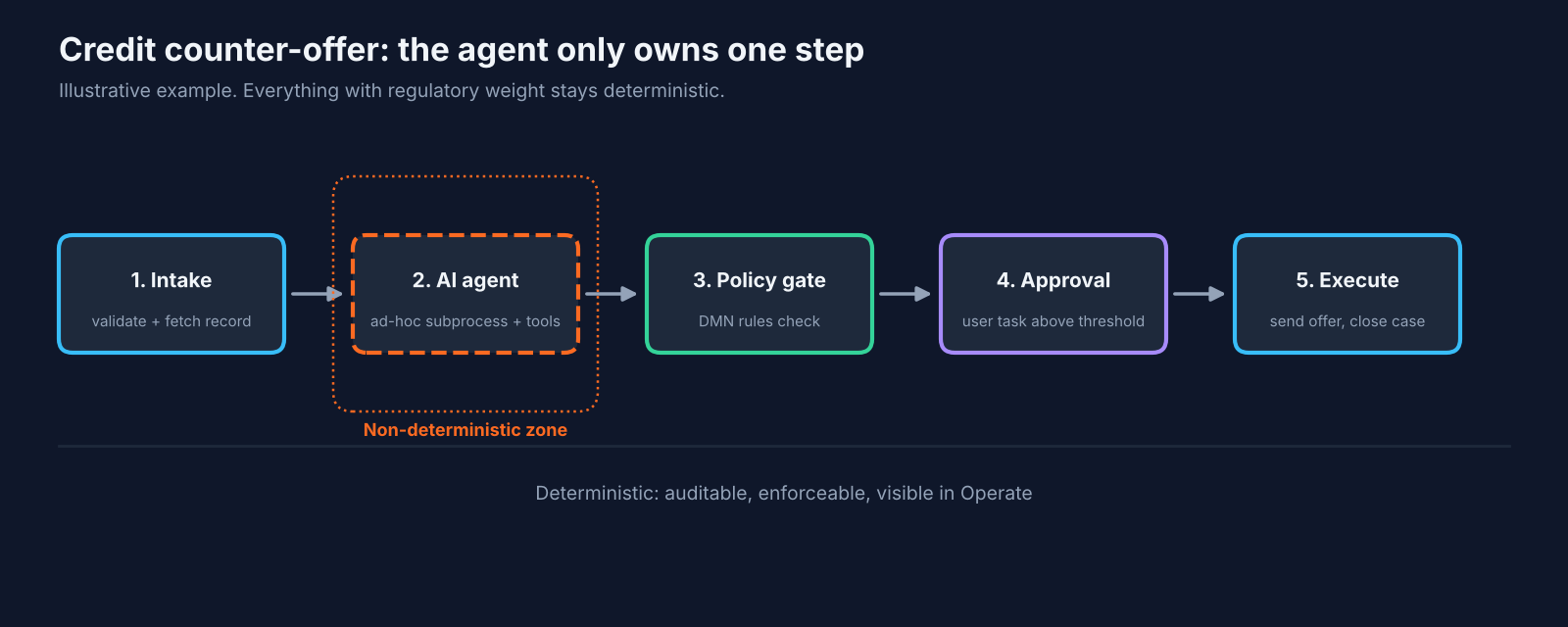
The credit counter-offer process: intake, AI agent, policy gate, human approval, execution. Only the agent step is non-deterministic.
In this illustrative credit counter-offer process, the agent only owns step 2. Intake, the policy gate, the human approval and the execution stay deterministic, which means they are auditable, enforceable and visible in Operate.
What 8.10 adds for trust
Based on Camunda’s own release announcement, these are the capabilities that matter most for production agents:
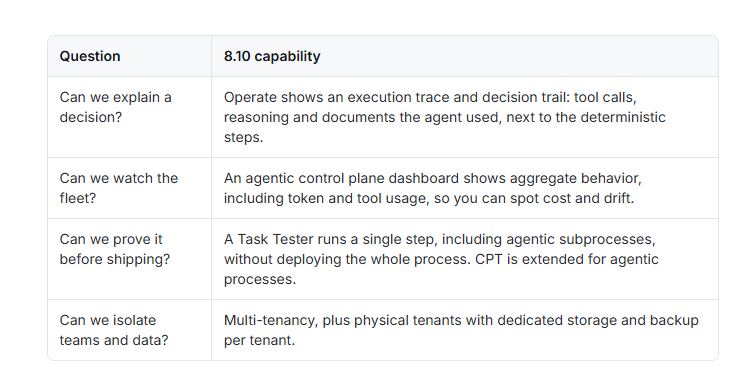
The announcement post contains screenshots of the Operate trace and the dashboard, so I link to it at the end instead of copying them.
Demo: prove the guardrails without an LLM
Here is the nice part. The guardrails live in the process, so you can test them with a mocked agent. No API key, no flakiness, no cost.
What you need: Java, Maven, Docker (CPT starts a test runtime with Testcontainers by default) and the Camunda Spring Boot Starter.
1. Add the test dependency
<dependency>
  <groupId>io.camunda</groupId>
  <artifactId>camunda-process-test-spring</artifactId>
  <version>${camunda.version}</version>
  <scope>test</scope>
</dependency>
If you use the dedicated Spring Boot 3 starter, use camunda-process-test-spring-boot-3 instead.
2. The process model
The demo model is credit-offer.bpmn (the full file is in the appendix at the end of this article). Save it in src/test/resources. It has these elements, with the job types the tests will mock:
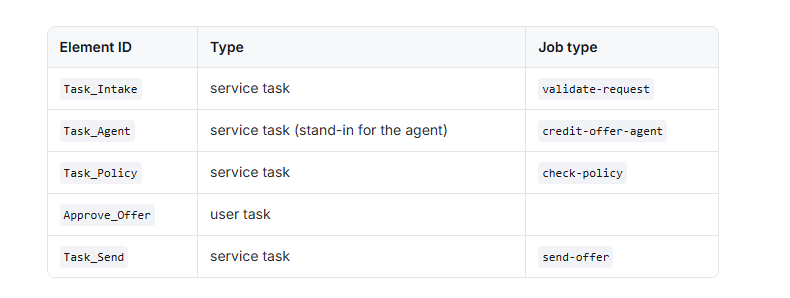
Routing: if policyApproved is false, the process ends at End_Rejected. If proposedAmount > 10000, a human must approve at Approve_Offer. Only then does Task_Send run.
In production, replace
Task_Agentwith an ad-hoc subprocess that uses the AI Agent connector. The guardrail tests stay exactly the same, because they only care about what happens around the agent.
3. The tests
@SpringBootTest(properties = {"camunda.client.worker.defaults.enabled=false"})
@CamundaSpringProcessTest
@TestDeployment(resources = "credit-offer.bpmn")
class CreditOfferGuardrailsTest {

  @SpringBootApplication
  static class TestProcessApplication {}

  @Autowired private CamundaClient client;
  @Autowired private CamundaProcessTestContext processTestContext;

  @BeforeEach
  void mockHappyPathWorkers() {
    processTestContext.mockJobWorker("validate-request").thenComplete();
    processTestContext.mockJobWorker("send-offer").thenComplete();
  }

  @Test
  void shouldNeverSendAnOfferWhenPolicyRejectsIt() {
    // the agent proposes a big offer, but the policy check says no
    processTestContext.mockJobWorker("credit-offer-agent")
        .thenComplete(Map.of("proposedAmount", 50_000));
    processTestContext.mockJobWorker("check-policy")
        .thenComplete(Map.of("policyApproved", false));

    ProcessInstanceEvent processInstance = startProcess();

    assertThat(processInstance).isCompleted();
    assertThat(processInstance).hasCompletedElements("End_Rejected");
    assertThat(processInstance).hasNotActivatedElements("Task_Send");
  }

  @Test
  void shouldWaitForHumanApprovalAboveTheThreshold() {
    processTestContext.mockJobWorker("credit-offer-agent")
        .thenComplete(Map.of("proposedAmount", 50_000));
    processTestContext.mockJobWorker("check-policy")
        .thenComplete(Map.of("policyApproved", true));

    ProcessInstanceEvent processInstance = startProcess();

    // parked at the human task, nothing sent yet
    assertThat(processInstance).hasActiveElements("Approve_Offer");
    assertThat(processInstance).hasNotActivatedElements("Task_Send");

    processTestContext.completeUserTask("Approve_Offer", Map.of("approved", true));

    assertThat(processInstance).isCompleted();
    assertThat(processInstance).hasCompletedElements("Task_Send", "End_Sent");
  }
}
The startProcess() helper just creates an instance of credit-offer with client.newCreateInstanceCommand(). The complete test class is in the appendix, including the remaining two cases: the human says no, and small amounts skip approval. Run everything with mvn test. CPT prints a coverage report for your BPMN model after the run, which is handy for spotting untested paths.
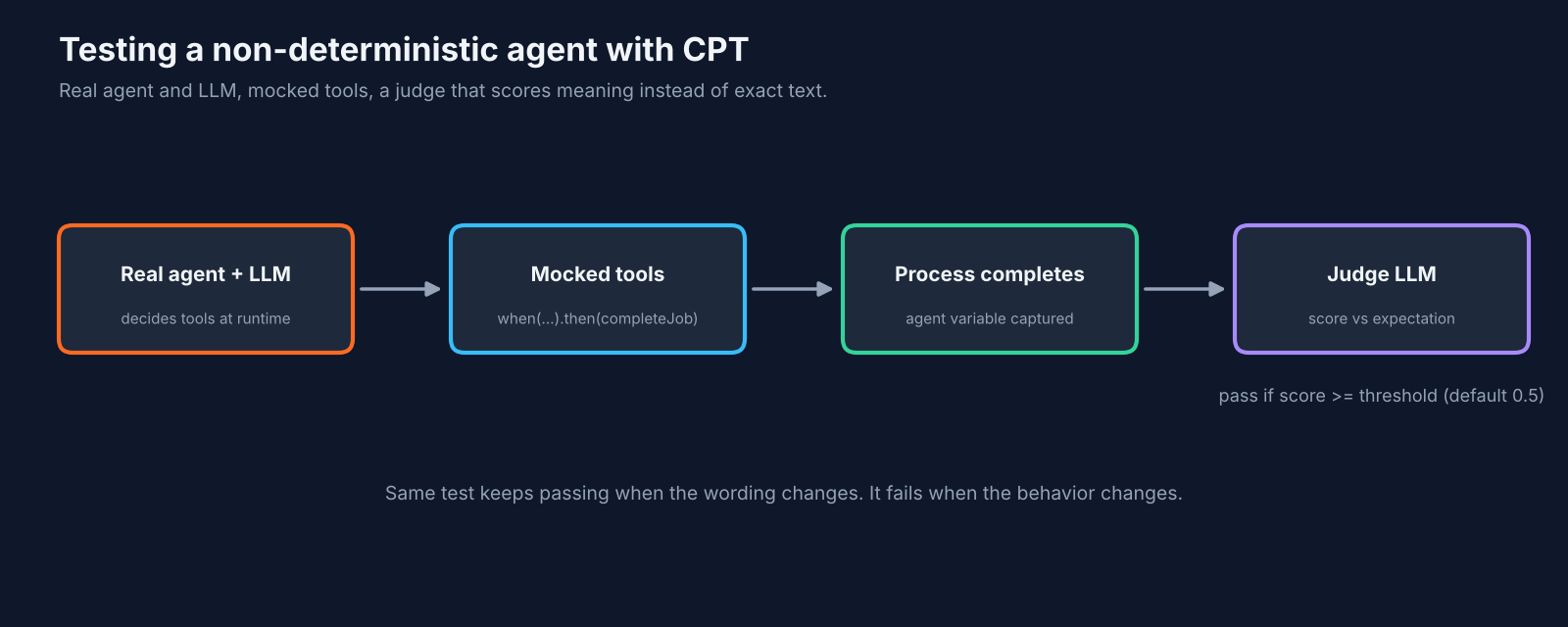
Flow of an agent test: real agent and LLM, mocked tools, process completes, judge LLM scores the result.
Testing the real agent: judge assertions
Guardrail tests prove the boundary. You still want to know whether the agent itself behaves. Agent output differs on every run, so exact string matching is useless. CPT (8.9 and later) offers two tools for this:
-
Judge assertions: a judge LLM scores whether a variable satisfies a natural-language expectation. The default pass threshold is 0.5.
-
Semantic similarity assertions: compare output to a reference text with embeddings. Cheaper and deterministic, but less flexible.
To keep the agent real but control its tools, you use conditional behavior: the test reacts to whichever tool the agent activates, instead of assuming a fixed order. This sketch follows the pattern in Camunda’s documentation. Adapt the element IDs to your model, and note that it needs the AI Agent connector and a configured judge model:
@Test
void shouldProposeAnOfferUsingTheCreditHistoryTool() {
  // react to whichever tool the agent decides to call
  processTestContext
      .when(() -> assertThatProcessInstance(ProcessInstanceSelectors.byProcessId("credit-offer"))
          .hasActiveElements("Fetch_Credit_History"))
      .as("complete credit history tool")
      .then(() -> processTestContext.completeJob(
          JobSelectors.byElementId("Fetch_Credit_History"),
          Map.of("toolCallResult", Map.of("score", 712, "defaults", 0))));

  ProcessInstanceEvent processInstance = startProcess();

  assertThat(processInstance)
      .withJudgeConfig(config -> config.withThreshold(0.8))
      .hasVariableSatisfiesJudge(
          "agent",
          """
          The agent used the credit history tool before proposing an offer.
          The proposed offer is consistent with a score of 712 and no defaults.
          """);
}
And the configuration for the judge, based on the documented Amazon Bedrock example (Ollama is also supported). A lighter model often works well as judge, because its context is small:
camunda:
  process-test:
    assertion:
      timeout: PT1M
    judge:
      chat-model:
        provider: "amazon-bedrock"
        model: "eu.anthropic.claude-haiku-4-5-20251001-v1:0"
        region: "eu-central-1"
        credentials:
          access-key: ${AWS_LLM_BEDROCK_ACCESS_KEY}
          secret-key: ${AWS_LLM_BEDROCK_SECRET_KEY}
Never commit credentials. Inject them with environment variables or your CI secret store.
A pre-production checklist
-
Does a deterministic policy check sit between the agent’s proposal and any irreversible action?
-
Is there a human approval path for high-risk outcomes?
-
Can I explain one specific past decision from the execution trace alone?
-
Do I re-run semantic tests whenever the model or prompt changes?
-
Does someone own the alert on token and tool usage?
-
Does tenant and data isolation match my compliance obligations?
A note on honesty
8.10 is brand new. Try these capabilities in your own environment with your own data before you promise anything to a stakeholder. If you want a live walkthrough, Camunda is running an 8.10 release webinar on November 4, 2026.
[YOUR EXPERIENCE: add 2-3 sentences about an agent or process you built, what surprised you and what you would do differently.]
The takeaway: stop asking whether your agent is smart enough. Ask whether your process makes it safe enough to trust.
Sources
Appendix: full demo files
Copy each file into a Spring Boot project that uses the Camunda Spring Boot Starter, with Docker running.
credit-offer.bpmn
<?xml version="1.0" encoding="UTF-8"?>
<bpmn:definitions xmlns:bpmn="http://www.omg.org/spec/BPMN/20100524/MODEL" xmlns:bpmndi="http://www.omg.org/spec/BPMN/20100524/DI" xmlns:dc="http://www.omg.org/spec/DD/20100524/DC" xmlns:di="http://www.omg.org/spec/DD/20100524/DI" xmlns:xsi="http://www.w3.org/2001/XMLSchema-instance" xmlns:zeebe="http://camunda.org/schema/zeebe/1.0" xmlns:modeler="http://camunda.org/schema/modeler/1.0" id="Definitions_credit_offer" targetNamespace="http://bpmn.io/schema/bpmn" modeler:executionPlatform="Camunda Cloud" modeler:executionPlatformVersion="8.10.0">
  <bpmn:process id="credit-offer" name="Credit counter-offer" isExecutable="true">
    <bpmn:startEvent id="Start_Request" name="Offer requested">
      <bpmn:outgoing>Flow_1</bpmn:outgoing>
    </bpmn:startEvent>
    <bpmn:serviceTask id="Task_Intake" name="Validate request">
      <bpmn:extensionElements>
        <zeebe:taskDefinition type="validate-request" />
      </bpmn:extensionElements>
      <bpmn:incoming>Flow_1</bpmn:incoming>
      <bpmn:outgoing>Flow_2</bpmn:outgoing>
    </bpmn:serviceTask>
    <bpmn:serviceTask id="Task_Agent" name="AI agent proposes offer">
      <bpmn:extensionElements>
        <zeebe:taskDefinition type="credit-offer-agent" />
      </bpmn:extensionElements>
      <bpmn:incoming>Flow_2</bpmn:incoming>
      <bpmn:outgoing>Flow_3</bpmn:outgoing>
    </bpmn:serviceTask>
    <bpmn:serviceTask id="Task_Policy" name="Check lending policy">
      <bpmn:extensionElements>
        <zeebe:taskDefinition type="check-policy" />
      </bpmn:extensionElements>
      <bpmn:incoming>Flow_3</bpmn:incoming>
      <bpmn:outgoing>Flow_4</bpmn:outgoing>
    </bpmn:serviceTask>
    <bpmn:serviceTask id="Task_Send" name="Send offer">
      <bpmn:extensionElements>
        <zeebe:taskDefinition type="send-offer" />
      </bpmn:extensionElements>
      <bpmn:incoming>Flow_SmallAmount</bpmn:incoming>
      <bpmn:incoming>Flow_Approved</bpmn:incoming>
      <bpmn:outgoing>Flow_6</bpmn:outgoing>
    </bpmn:serviceTask>
    <bpmn:userTask id="Approve_Offer" name="Approve offer">
      <bpmn:extensionElements>
        <zeebe:userTask />
      </bpmn:extensionElements>
      <bpmn:incoming>Flow_NeedsApproval</bpmn:incoming>
      <bpmn:outgoing>Flow_5</bpmn:outgoing>
    </bpmn:userTask>
    <bpmn:exclusiveGateway id="Gateway_Policy" name="Policy OK?" default="Flow_PolicyRejected">
      <bpmn:incoming>Flow_4</bpmn:incoming>
      <bpmn:outgoing>Flow_PolicyOk</bpmn:outgoing>
      <bpmn:outgoing>Flow_PolicyRejected</bpmn:outgoing>
    </bpmn:exclusiveGateway>
    <bpmn:exclusiveGateway id="Gateway_Threshold" name="Above threshold?" default="Flow_SmallAmount">
      <bpmn:incoming>Flow_PolicyOk</bpmn:incoming>
      <bpmn:outgoing>Flow_NeedsApproval</bpmn:outgoing>
      <bpmn:outgoing>Flow_SmallAmount</bpmn:outgoing>
    </bpmn:exclusiveGateway>
    <bpmn:exclusiveGateway id="Gateway_Approved" name="Approved?" default="Flow_NotApproved">
      <bpmn:incoming>Flow_5</bpmn:incoming>
      <bpmn:outgoing>Flow_Approved</bpmn:outgoing>
      <bpmn:outgoing>Flow_NotApproved</bpmn:outgoing>
    </bpmn:exclusiveGateway>
    <bpmn:endEvent id="End_Sent" name="Offer sent">
      <bpmn:incoming>Flow_6</bpmn:incoming>
    </bpmn:endEvent>
    <bpmn:endEvent id="End_Rejected" name="Offer rejected">
      <bpmn:incoming>Flow_PolicyRejected</bpmn:incoming>
      <bpmn:incoming>Flow_NotApproved</bpmn:incoming>
    </bpmn:endEvent>
    <bpmn:sequenceFlow id="Flow_1" sourceRef="Start_Request" targetRef="Task_Intake" />
    <bpmn:sequenceFlow id="Flow_2" sourceRef="Task_Intake" targetRef="Task_Agent" />
    <bpmn:sequenceFlow id="Flow_3" sourceRef="Task_Agent" targetRef="Task_Policy" />
    <bpmn:sequenceFlow id="Flow_4" sourceRef="Task_Policy" targetRef="Gateway_Policy" />
    <bpmn:sequenceFlow id="Flow_PolicyOk" sourceRef="Gateway_Policy" targetRef="Gateway_Threshold">
      <bpmn:conditionExpression xsi:type="bpmn:tFormalExpression">= policyApproved = true</bpmn:conditionExpression>
    </bpmn:sequenceFlow>
    <bpmn:sequenceFlow id="Flow_PolicyRejected" sourceRef="Gateway_Policy" targetRef="End_Rejected" />
    <bpmn:sequenceFlow id="Flow_NeedsApproval" sourceRef="Gateway_Threshold" targetRef="Approve_Offer">
      <bpmn:conditionExpression xsi:type="bpmn:tFormalExpression">= proposedAmount > 10000</bpmn:conditionExpression>
    </bpmn:sequenceFlow>
    <bpmn:sequenceFlow id="Flow_SmallAmount" sourceRef="Gateway_Threshold" targetRef="Task_Send" />
    <bpmn:sequenceFlow id="Flow_5" sourceRef="Approve_Offer" targetRef="Gateway_Approved" />
    <bpmn:sequenceFlow id="Flow_Approved" sourceRef="Gateway_Approved" targetRef="Task_Send">
      <bpmn:conditionExpression xsi:type="bpmn:tFormalExpression">= approved = true</bpmn:conditionExpression>
    </bpmn:sequenceFlow>
    <bpmn:sequenceFlow id="Flow_NotApproved" sourceRef="Gateway_Approved" targetRef="End_Rejected" />
    <bpmn:sequenceFlow id="Flow_6" sourceRef="Task_Send" targetRef="End_Sent" />
  </bpmn:process>
  <bpmndi:BPMNDiagram id="BPMNDiagram_1">
    <bpmndi:BPMNPlane id="BPMNPlane_1" bpmnElement="credit-offer">
      <bpmndi:BPMNShape id="Start_Request_di" bpmnElement="Start_Request">
        <dc:Bounds x="152" y="182" width="36" height="36" />
      </bpmndi:BPMNShape>
      <bpmndi:BPMNShape id="Task_Intake_di" bpmnElement="Task_Intake">
        <dc:Bounds x="240" y="160" width="100" height="80" />
      </bpmndi:BPMNShape>
      <bpmndi:BPMNShape id="Task_Agent_di" bpmnElement="Task_Agent">
        <dc:Bounds x="390" y="160" width="100" height="80" />
      </bpmndi:BPMNShape>
      <bpmndi:BPMNShape id="Task_Policy_di" bpmnElement="Task_Policy">
        <dc:Bounds x="540" y="160" width="100" height="80" />
      </bpmndi:BPMNShape>
      <bpmndi:BPMNShape id="Task_Send_di" bpmnElement="Task_Send">
        <dc:Bounds x="1090" y="160" width="100" height="80" />
      </bpmndi:BPMNShape>
      <bpmndi:BPMNShape id="Approve_Offer_di" bpmnElement="Approve_Offer">
        <dc:Bounds x="865" y="160" width="100" height="80" />
      </bpmndi:BPMNShape>
      <bpmndi:BPMNShape id="Gateway_Policy_di" bpmnElement="Gateway_Policy" isMarkerVisible="true">
        <dc:Bounds x="665" y="175" width="50" height="50" />
      </bpmndi:BPMNShape>
      <bpmndi:BPMNShape id="Gateway_Threshold_di" bpmnElement="Gateway_Threshold" isMarkerVisible="true">
        <dc:Bounds x="765" y="175" width="50" height="50" />
      </bpmndi:BPMNShape>
      <bpmndi:BPMNShape id="Gateway_Approved_di" bpmnElement="Gateway_Approved" isMarkerVisible="true">
        <dc:Bounds x="990" y="175" width="50" height="50" />
      </bpmndi:BPMNShape>
      <bpmndi:BPMNShape id="End_Sent_di" bpmnElement="End_Sent">
        <dc:Bounds x="1262" y="182" width="36" height="36" />
      </bpmndi:BPMNShape>
      <bpmndi:BPMNShape id="End_Rejected_di" bpmnElement="End_Rejected">
        <dc:Bounds x="672" y="382" width="36" height="36" />
      </bpmndi:BPMNShape>
      <bpmndi:BPMNEdge id="Flow_1_di" bpmnElement="Flow_1">
        <di:waypoint x="188" y="200" />
        <di:waypoint x="240" y="200" />
      </bpmndi:BPMNEdge>
      <bpmndi:BPMNEdge id="Flow_2_di" bpmnElement="Flow_2">
        <di:waypoint x="340" y="200" />
        <di:waypoint x="390" y="200" />
      </bpmndi:BPMNEdge>
      <bpmndi:BPMNEdge id="Flow_3_di" bpmnElement="Flow_3">
        <di:waypoint x="490" y="200" />
        <di:waypoint x="540" y="200" />
      </bpmndi:BPMNEdge>
      <bpmndi:BPMNEdge id="Flow_4_di" bpmnElement="Flow_4">
        <di:waypoint x="640" y="200" />
        <di:waypoint x="665" y="200" />
      </bpmndi:BPMNEdge>
      <bpmndi:BPMNEdge id="Flow_PolicyOk_di" bpmnElement="Flow_PolicyOk">
        <di:waypoint x="715" y="200" />
        <di:waypoint x="765" y="200" />
      </bpmndi:BPMNEdge>
      <bpmndi:BPMNEdge id="Flow_PolicyRejected_di" bpmnElement="Flow_PolicyRejected">
        <di:waypoint x="690" y="225" />
        <di:waypoint x="690" y="382" />
      </bpmndi:BPMNEdge>
      <bpmndi:BPMNEdge id="Flow_NeedsApproval_di" bpmnElement="Flow_NeedsApproval">
        <di:waypoint x="815" y="200" />
        <di:waypoint x="865" y="200" />
      </bpmndi:BPMNEdge>
      <bpmndi:BPMNEdge id="Flow_SmallAmount_di" bpmnElement="Flow_SmallAmount">
        <di:waypoint x="790" y="225" />
        <di:waypoint x="790" y="320" />
        <di:waypoint x="1140" y="320" />
        <di:waypoint x="1140" y="240" />
      </bpmndi:BPMNEdge>
      <bpmndi:BPMNEdge id="Flow_5_di" bpmnElement="Flow_5">
        <di:waypoint x="965" y="200" />
        <di:waypoint x="990" y="200" />
      </bpmndi:BPMNEdge>
      <bpmndi:BPMNEdge id="Flow_Approved_di" bpmnElement="Flow_Approved">
        <di:waypoint x="1040" y="200" />
        <di:waypoint x="1090" y="200" />
      </bpmndi:BPMNEdge>
      <bpmndi:BPMNEdge id="Flow_NotApproved_di" bpmnElement="Flow_NotApproved">
        <di:waypoint x="1015" y="225" />
        <di:waypoint x="1015" y="400" />
        <di:waypoint x="708" y="400" />
      </bpmndi:BPMNEdge>
      <bpmndi:BPMNEdge id="Flow_6_di" bpmnElement="Flow_6">
        <di:waypoint x="1190" y="200" />
        <di:waypoint x="1262" y="200" />
      </bpmndi:BPMNEdge>
    </bpmndi:BPMNPlane>
  </bpmndi:BPMNDiagram>
</bpmn:definitions>
CreditOfferGuardrailsTest.java
package com.example;

import static io.camunda.process.test.api.CamundaAssert.assertThat;

import io.camunda.client.CamundaClient;
import io.camunda.client.api.response.ProcessInstanceEvent;
import io.camunda.process.test.api.CamundaProcessTestContext;
import io.camunda.process.test.api.CamundaSpringProcessTest;
import io.camunda.process.test.api.TestDeployment;
import java.util.Map;
import org.junit.jupiter.api.BeforeEach;
import org.junit.jupiter.api.Test;
import org.springframework.beans.factory.annotation.Autowired;
import org.springframework.boot.autoconfigure.SpringBootApplication;
import org.springframework.boot.test.context.SpringBootTest;

/**
 * Guardrail tests for the credit-offer process.
 *
 * The agent step is mocked with a job worker, so these tests are deterministic,
 * fast and need no LLM. They prove that the process, not the agent, decides what
 * is allowed to happen.
 */
@SpringBootTest(properties = {"camunda.client.worker.defaults.enabled=false"})
@CamundaSpringProcessTest
@TestDeployment(resources = "credit-offer.bpmn")
class CreditOfferGuardrailsTest {

  @SpringBootApplication
  static class TestProcessApplication {}

  @Autowired private CamundaClient client;
  @Autowired private CamundaProcessTestContext processTestContext;

  @BeforeEach
  void mockHappyPathWorkers() {
    processTestContext.mockJobWorker("validate-request").thenComplete();
    processTestContext.mockJobWorker("send-offer").thenComplete();
  }

  private ProcessInstanceEvent startProcess() {
    return client
        .newCreateInstanceCommand()
        .bpmnProcessId("credit-offer")
        .latestVersion()
        .variables(Map.of("customerId", "C-1001"))
        .send()
        .join();
  }

  @Test
  void shouldNeverSendAnOfferWhenPolicyRejectsIt() {
    // given: the agent proposes a big offer, but the policy check says no
    processTestContext
        .mockJobWorker("credit-offer-agent")
        .thenComplete(Map.of("proposedAmount", 50_000));
    processTestContext
        .mockJobWorker("check-policy")
        .thenComplete(Map.of("policyApproved", false));

    // when
    final ProcessInstanceEvent processInstance = startProcess();

    // then: the process ends as rejected and the send step was never activated
    assertThat(processInstance).isCompleted();
    assertThat(processInstance).hasCompletedElements("End_Rejected");
    assertThat(processInstance).hasNotActivatedElements("Task_Send");
  }

  @Test
  void shouldWaitForHumanApprovalAboveTheThreshold() {
    // given: policy passes, but the amount is above 10 000
    processTestContext
        .mockJobWorker("credit-offer-agent")
        .thenComplete(Map.of("proposedAmount", 50_000));
    processTestContext
        .mockJobWorker("check-policy")
        .thenComplete(Map.of("policyApproved", true));

    // when
    final ProcessInstanceEvent processInstance = startProcess();

    // then: the process is parked at the human task and nothing was sent yet
    assertThat(processInstance).hasActiveElements("Approve_Offer");
    assertThat(processInstance).hasNotActivatedElements("Task_Send");

    // when: a human approves
    processTestContext.completeUserTask("Approve_Offer", Map.of("approved", true));

    // then: only now is the offer sent
    assertThat(processInstance).isCompleted();
    assertThat(processInstance).hasCompletedElements("Task_Send", "End_Sent");
  }

  @Test
  void shouldNotSendWhenTheHumanSaysNo() {
    processTestContext
        .mockJobWorker("credit-offer-agent")
        .thenComplete(Map.of("proposedAmount", 50_000));
    processTestContext
        .mockJobWorker("check-policy")
        .thenComplete(Map.of("policyApproved", true));

    final ProcessInstanceEvent processInstance = startProcess();

    processTestContext.completeUserTask("Approve_Offer", Map.of("approved", false));

    assertThat(processInstance).isCompleted();
    assertThat(processInstance).hasCompletedElements("End_Rejected");
    assertThat(processInstance).hasNotActivatedElements("Task_Send");
  }

  @Test
  void shouldSkipApprovalForSmallAmounts() {
    processTestContext
        .mockJobWorker("credit-offer-agent")
        .thenComplete(Map.of("proposedAmount", 2_000));
    processTestContext
        .mockJobWorker("check-policy")
        .thenComplete(Map.of("policyApproved", true));

    final ProcessInstanceEvent processInstance = startProcess();

    assertThat(processInstance).isCompleted();
    assertThat(processInstance).hasNotActivatedElements("Approve_Offer");
    assertThat(processInstance).hasCompletedElements("Task_Send", "End_Sent");
  }
}
application.yaml
# Only needed for the LLM-backed agent test (Article 1, section "Testing the real agent").
# The guardrail tests above run without any of this.
camunda:
  process-test:
    assertion:
      timeout: PT1M
    judge:
      chat-model:
        provider: "amazon-bedrock"
        model: "eu.anthropic.claude-haiku-4-5-20251001-v1:0"
        region: "eu-central-1"
        credentials:
          access-key: ${AWS_LLM_BEDROCK_ACCESS_KEY}
          secret-key: ${AWS_LLM_BEDROCK_SECRET_KEY}
Developed by Piko Dev => Hamza Braimi 

